
How Si3 Helped a Client Reclaim Control of a Mission-Critical Operational System
When I was first engaged as a fractional CTO for a growing therapeutic services company, the expectation was fairly typical: evaluate systems, improve operational efficiency, help align technology decisions with business growth, and identify opportunities for modernization. At first glance, the organization did not appear to have a device engineering problem. It appeared to have a scaling problem.
But as I spent time studying the business, interviewing staff, reviewing workflows, and tracing operational bottlenecks through the organization, a pattern began to emerge. Many of the company’s biggest operational headaches traced back to a single point of failure: the most profitable product in their entire catalog.
The organization depended heavily on a fleet of therapeutic devices that failed constantly. Not catastrophic failures every day, but the kind of recurring reliability and maintenance problems that slowly bleed a business dry over time. Repairs were expensive. Shipping was expensive. Downtime was expensive. Customer frustration was expensive.
Worst of all, the company didn’t truly control the ecosystem surrounding the devices. Every significant repair had to flow back through the original manufacturer. Costs were high. Turnaround times were inconsistent. Millions of dollars in deployed equipment effectively locked the company into dependence on a vendor whose incentives were not aligned with the operational realities of the client.
The business had unknowingly become trapped inside its own infrastructure. That realization changed the nature of the engagement entirely. What started as a fractional CTO role evolved into a systems-engineering and operational transformation initiative. And that required going far deeper than software.
I converted a room in my home into a functional engineering laboratory focused on reverse engineering, component analysis, reliability testing, and rapid iterative prototyping.
Tables disappeared under wiring harnesses, pumps, fittings, motors, tubing samples, oscilloscopes, soldering stations, firmware test rigs, and prototype assemblies. Some nights involved firmware debugging until two in the morning. Other days involved acoustic testing, thermal testing, component sourcing, or failure-mode analysis.
There were moments where the work became almost absurdly granular. At one point, I spent significant time evaluating solder characteristics for gaps barely visible to the eye. At another point, I narrowed dozens of motor candidates down to nine finalists and physically tested each one to identify the right operational profile for the system. The final motor selection became one of the defining moments of the project.
The chosen motor was nearly silent during operation and carried an estimated lifespan of 20,000 operational hours. Comparable systems in the market reportedly averaged closer to 1,000 hours before major failure events, and excessive operational noise had become one of the most common customer complaints.
That wasn’t just a hardware improvement. It was an operational improvement. That distinction matters.
One of the biggest lessons reinforced during this engagement was that successful systems engineering is rarely about making a device merely “work.” Most products can be made functional. What matters is understanding the operational ecosystem surrounding the technology.
The acoustics matter because users interact with the sound every day. The maintainability matters because technicians inherit the repair burden. The firmware architecture matters because iteration speed affects future adaptability. The UI matters because friction compounds over thousands of interactions.
The component lifecycle matters because downtime impacts trust, logistics, staffing, and profitability. Every engineering decision propagates outward into business consequences.
As the project evolved, we also began integrating AI-assisted development workflows into portions of the firmware and interface iteration process. Under disciplined engineering oversight, plain-English workflows could accelerate modifications, validate impacts, test interface adjustments, and dramatically compress iteration timelines. The important realization was not that AI replaced engineering expertise. It didn’t.
The realization was that experienced systems engineering combined with AI-assisted workflows creates an entirely different rate of progress.
Small teams can now solve problems that once required enormous engineering organizations.
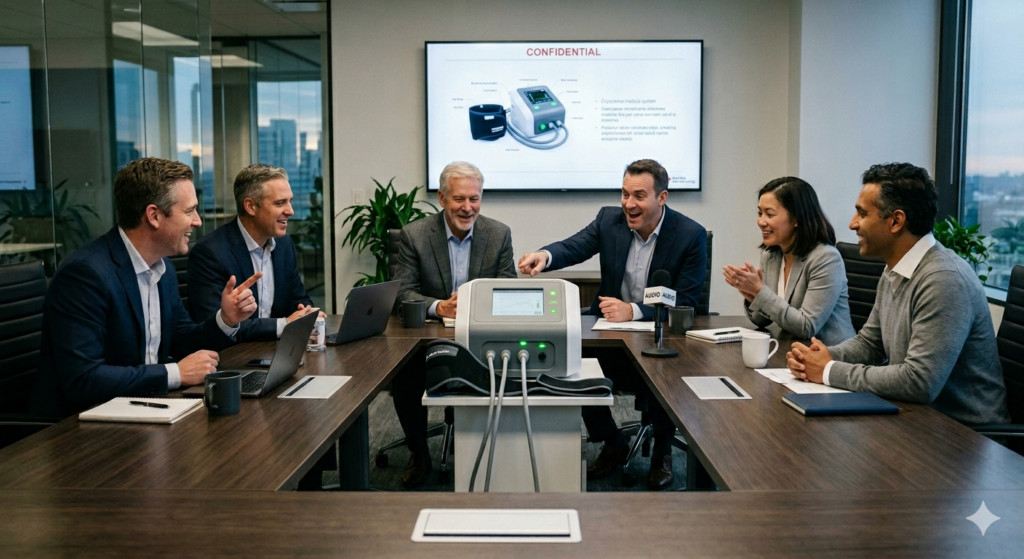
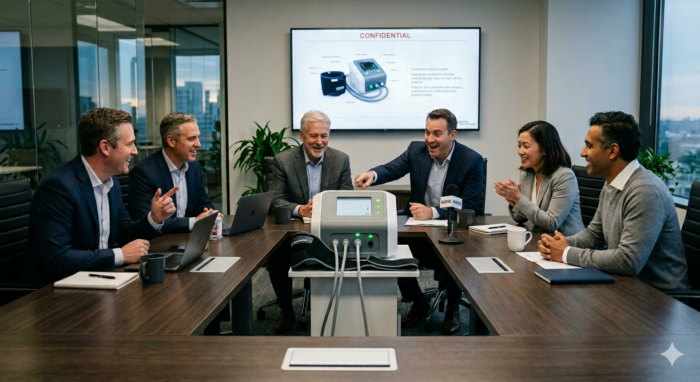
Recently, I sat in a live video call while the latest prototype operated quietly on a conference table in front of stakeholders and manufacturing partners. Several people in the room had never seen the fully integrated system functioning before.
The room got quiet. Then people started leaning in.
One person commented that they couldn’t even hear the pump running. Another began exploring the maintenance interface. The conversation rapidly shifted away from “Can this work?” and toward refinements, deployment planning, and manufacturing considerations. That transition is one of the most rewarding moments in engineering. Not because of ego, but because an idea crossed the boundary into operational reality.
What excites us most about this project is not simply the device itself. It’s what the project represents.
We are entering an era where organizations no longer need massive bureaucratic engineering structures to solve deeply complex operational problems. Small, disciplined teams with systems-thinking experience, operational awareness, and AI-assisted workflows can now move from concept to functional capability at remarkable speed.
But the technology alone is not the differentiator.
The differentiator is understanding the system as a whole.
That is the work we love doing at Si3: Systems Innovation, Integration, and Incubation.